
Our approach
Change in the capability uplift space is unrelenting. Learning and Development teams are being pressed to re-evaluate their role, their processes, and their engagement in the organisation. At the same time they need to deliver BAU outputs. A structured approach to building Learning and Development capability is key to any organisation thriving in the changing environment they face.
Synapsys builds L&D capability through a structured but flexible process that recognises that you can’t do everything all at once. Our approach to L&D capability build services are framed around:
- Building shared understanding of current L&D capacity and capability, and of the contribution it is expected to make to the wider business.
- The identification of the highest value opportunities for investing in uplifting organisational L&D capability.
- The design of activity that will best deliver on those opportunities, given the pragmatic reality of the function and the wider organisation.
When we talk about capability, we think more widely than the competencies or capabilities of the L&D team. We are talking about the capability of the function itself to deliver, inclusive of the people, of the systems and processes, and of the engagement of the function in the wider organisation.
- Our model is informed by a number of L&D capability/maturity frameworks:
- ISO 30422:2022 Human Resources Management – Learning and Development
- ATD Talent Development Capability Model
- CIPD Profession Map (L&D specialisation)
- The LPI Capability Map
- The Mind Tools Learning Performance Benchmark
- Bersin High-Impact Learning Organisation Maturity Model
It is also framed around the Aotearoa New Zealand context and challenges. We draw directly on our 20+ years of experience partnering with Government, corporate and education entities on L&D and wider capability uplift initiatives.
Our model recognises that L&D capability should be viewed from a systems perspective, recognising that a cycle of thought and activity underpins effective functioning (rather than discrete skillsets or siloed processes). It is framed around the changing expectations we see emerging for L&D, inclusive of:
Better engaging with the business to inform business cases around outputs and KPIs rather than learning outcomes
Embedding capability uplift experiences in the business (flow of work), requiring stronger governance and collaboration with the business
Innovation in technology adoption and application including AI (process improvement/efficiency as well as innovation in learning experiences)
Measuring and reporting impact and value through time, in preference to reporting learning activity and knowledge acquisition.
Our model
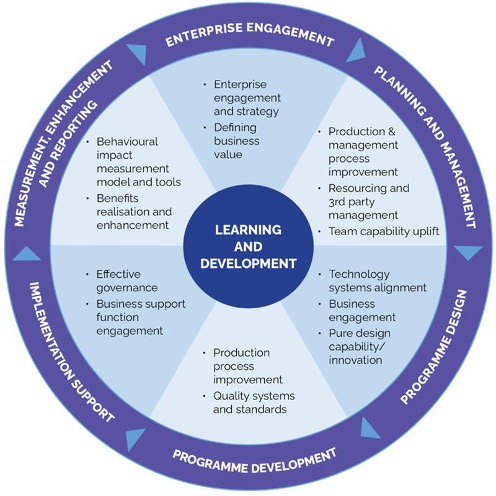
L&D capability uplift in recent years has, in our experience, revolved around the following themes (mapped to our model).
Learning and development capability starts and ultimately ends with enterprise engagement. Mature L&D functions are welcome at the leadership table, making the case for how capability uplift will deliver business value. Capabilities here include truly understanding the business itself, knowing where learning/capability uplift can and cannot advance strategy, and knowing how to make the case for investment.
Process rigour is key to effective function planning and management, delivering efficiency, and maximising resource utilisation. Toolsets embed sound learning design and ensure quality product.
In terms of programme design, building capability is focused on ensuring that capability uplift is embedded in the flow of work and leveraging new technologies to innovate experience design (for example, having AI surface training in the moment of need).
Emerging programme development capabilities include leveraging AI to accelerate production and engaging with SMEs. Process efficiency with embedded quality standards in tools and systems is key in the current economic climate. So too are effective third-party supplier management and the judicious use of COTS content.
Implementation support is now much broader than train the trainer and delivery facilitation. The key capability is to work with change and related support services to maximise the realisation of the benefits detailed in the original vision, typically through embedding behavioural change.
The L&D cycle is complete when a robust evaluation and measurement framework evidences the extent to which behaviour has shifted as a consequence of investment and the benefits this shift has delivered to the business.
Partnering
Here’s how we’ll partner with you to build your L&D capability.
Step One: Clarity
Clarity on what is expected of Learning and Development, and the building blocks that currently exist. We assess your current capability against our model, and establish where alignment exists with organisational expectations, and where the highest value opportunities lie.
Step Two: Certainty
Certainty on the pathway forward. We’ll partner with you to define the uplift pathway that will deliver the greatest value to your organisation, and enhance the performance of your team.
Stage 3: Confidence
Confidence to act. Your implementation pathway will:
- Build on the strengths of your existing capability
- Draw on proven innovation models
- Target genuine business value
- Be real around your context and budget.
Call us if you’re ready to change the L&D game in your organisation.